Last updated on 11 Aug, 2026
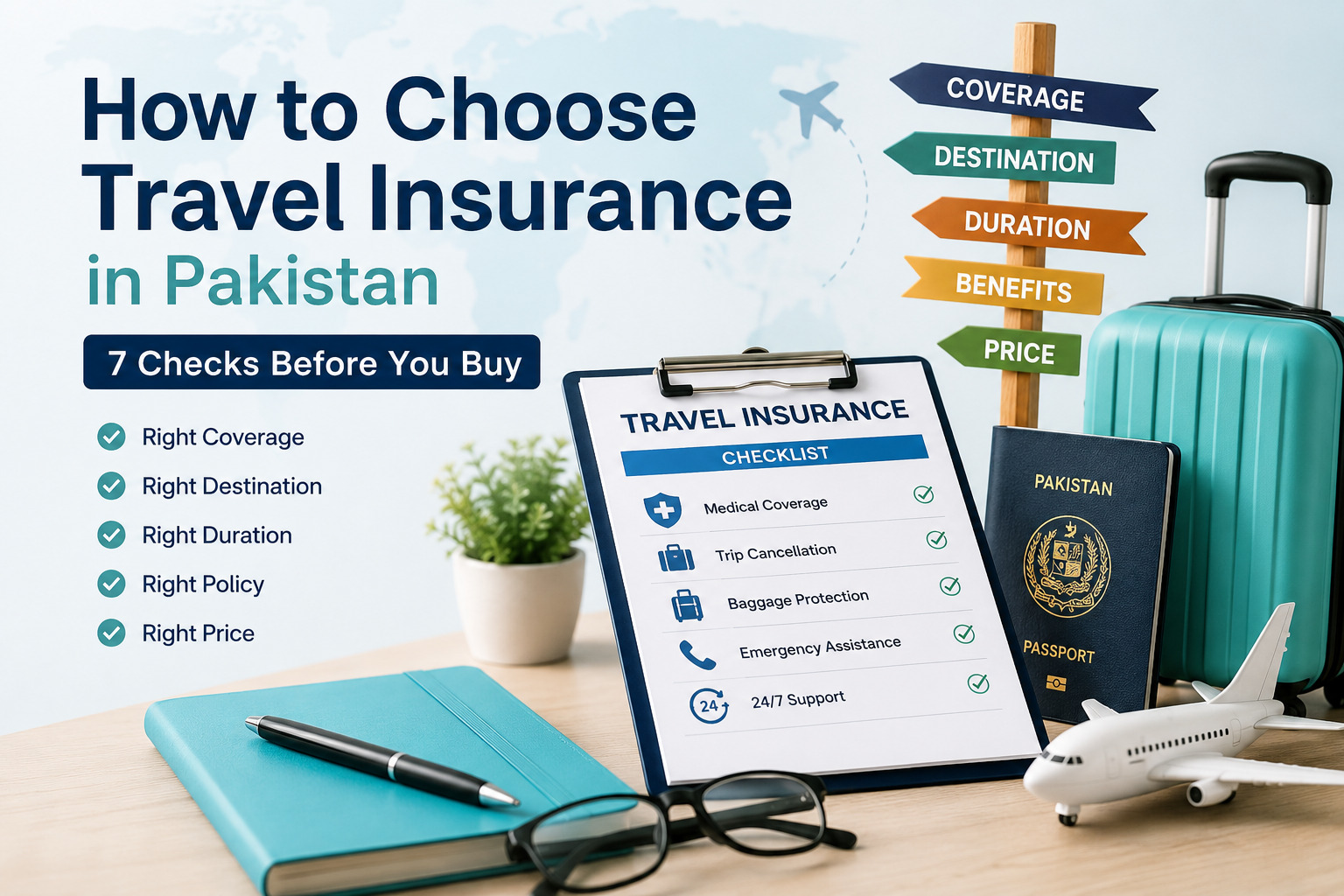
How to Choose Travel Insurance in Pakistan: 7 Checks Before You Buy
Choosing travel insurance can feel confusing when several policies appear to offer similar benefits. The lowest price is not always the best choice, and the policy with the longest list of benefits may not be necessary for every traveler.
The better approach is to start with your actual trip and then select insurance around it.
Whether you are leaving Pakistan for a holiday, studying overseas, attending a business event, visiting family, or applying for a visa, the right policy should match your destination, travel dates, purpose of travel and personal requirements.
This guide gives you a simple way to decide which travel insurance makes sense for your journey before you spend money on a policy.
Quick Answer: How Do I Choose the Right Travel Insurance?
Start with these seven checks:
- Where are you travelling?
- Why are you travelling?
- How long will you stay?
- Does your destination have an insurance requirement?
- Which situations do you actually need protection for?
- What exclusions could affect your trip?
- Does the policy offer reasonable value for its price?
If a policy fits these seven areas, you are much less likely to choose coverage simply because it is cheap or because it has the most features.
1. Start With Your Trip, Not the Insurance Company
A common mistake is to search for an insurance company first and decide what coverage is needed afterward.
Reverse the process.
Before looking at providers, write down four simple details:
- Destination
- Travel dates
- Purpose of travel
- Type of traveler
For example, someone travelling from Pakistan to Europe for ten days has a very different requirement from a Pakistani student moving abroad for several months.
Likewise, a business traveler making several short international trips may need a different solution from someone taking one family holiday.
Your destination and travel purpose should therefore be the starting point.
A simple way to think about it:
Your trip → your requirements → suitable policy → price → final decision
Note:
Lowest price → policy → hope it covers everything
This small change can prevent many expensive mistakes.
2. Which Travel Insurance Type Fits Your Journey?
There is no single policy that is automatically the best for every traveler.
Your first decision should be identifying the type of journey you are taking.
| Your situation |
What to focus on first |
Why it matters |
| Holiday or tourism |
Medical protection and trip dates |
Short trips still carry unexpected risks |
| Student travelling abroad |
Duration and destination-specific requirements |
Study periods can be much longer than normal holidays |
| Schengen visa applicant |
Visa-compliant medical protection |
Incorrect insurance can create problems during the visa process |
| Business traveler |
Flexibility and assistance |
Business schedules can change unexpectedly |
| Family trip |
Requirements for every traveler |
One person's needs may differ from another's |
| Frequent international traveler |
Whether a multi-trip option suits you |
Repeated single-trip purchases may not be convenient |
| Visiting relatives overseas |
Destination and duration |
Long stays may require closer attention to policy terms |
The important point is that “best travel insurance” is not one universal product.
The best option is the one that makes sense for the specific journey you are about to take.
3. Check the Destination Before You Check the Price
Your destination can change the insurance requirements you need to consider.
For example, travelers applying for a Schengen visa need travel medical insurance that is valid throughout the relevant territory and covers the required period. Under the EU Visa Code, the minimum coverage is €30,000, including specified medical-related expenses.
That means a traveler should not simply choose the cheapest policy displayed online.
Instead, ask:
- Is the policy valid for my destination?
- Does it satisfy the destination's visa requirements?
- Are the travel dates correctly covered?
- Is the coverage amount sufficient?
- Will the policy document provide the information required for my application?
This is particularly important when insurance is being purchased for a visa application.
Destination-first checklist
Before purchasing, confirm:
Destination → Visa requirement → Coverage requirement → Validity dates → Policy document
Once these are correct, you can move on to price and additional benefits.
4. Don't Judge a Policy Only by Its Price
Price is important, especially for travelers arranging a trip from Pakistan, but price should be treated as one part of the decision rather than the entire decision.
Two policies can have different prices because their benefits, limits, exclusions or conditions are different.
Instead of asking:
“Which policy is cheapest?”
ask:
“What am I getting for the price I am paying?”
Look at these five things together:
- Medical protection
- Coverage limits
- Important exclusions
- Assistance or support arrangements
- Policy validity
A very cheap policy may look attractive at first but become less useful if an important situation is excluded.
On the other hand, paying for benefits you are unlikely to need may also be unnecessary.
The goal is not to buy the cheapest insurance or the most expensive insurance.
The goal is to buy appropriate insurance at a sensible price.
5. What Should You Check Before Buying Any Policy?
Once you have found a policy that appears suitable, slow down before making the payment.
Read the key policy details.
Use this 7-point policy check:
1. Destination
Make sure your destination is included.
2. Dates
Check the start and end dates carefully.
3. Medical protection
Understand what medical situations are included and what limits apply.
4. Exclusions
Look for activities, conditions or situations that are specifically excluded.
5. Emergency assistance
Understand how assistance works if something goes wrong abroad.
6. Claim requirements
Know what documents or evidence may be required if you need to make a claim.
7. Policy document
Check your personal information, passport details, destination and dates before using the document for travel or visa purposes.
This seven-point check takes only a few minutes but can make your purchase much more informed.
6. The Fine Print Matters More Than the Marketing
Insurance pages often highlight benefits because benefits are easy to understand.
The less visible part is the exclusions and conditions.
This is where travelers should pay close attention.
For example, depending on the policy, certain activities, circumstances or pre-existing medical conditions may have specific limitations or exclusions.
That does not automatically make a policy bad.
It simply means you need to know what the policy actually promises.
Before purchasing, ask:
- What is not covered?
- Are there activity-related exclusions?
- Are there age-related conditions?
- Are there destination restrictions?
- Are there special requirements for claims?
- Are there limits on particular benefits?
- Is the policy suitable for the full duration of my journey?
A policy should be judged by its actual terms, not just by its headline.
7. Your Best Option Depends on What Could Go Wrong
A useful way to choose insurance is to think about the situations that could realistically affect your trip.

Instead of looking at twenty different benefits, ask:
“What would create the biggest problem for me if it happened abroad?”
For one traveler, the biggest concern may be a medical emergency.
For another, it may be meeting a visa requirement.
For a student, duration and destination requirements may be more important.
For a frequent traveler, convenience may matter more.
For a family, the needs of several people must be considered together.
Decision guide
| If your biggest concern is… |
Pay particular attention to… |
| Visa application |
Destination requirements and policy validity |
| Medical emergency |
Medical benefits and applicable limits |
| Long overseas stay |
Duration and eligibility |
| Several trips |
Whether multi-trip coverage is suitable |
| Family travel |
Each insured person's terms |
| Adventure activities |
Activity-related exclusions |
| Claim problems |
Claim procedure and required documentation |
| Saving money |
Value rather than price alone |
This approach makes the decision much easier because you are choosing around real needs, not marketing labels.
8. A 5-Minute Travel Insurance Decision Test
Before you buy, answer these questions.
Question 1: Where am I going?
Write the exact country or countries.
Question 2: How long am I staying?
Check your departure and return dates.
Question 3: Why am I travelling?
Tourism, study, business, family visit or another purpose?
Question 4: Do I need insurance for a visa?
If yes, check the destination's requirements before purchasing.
Question 5: What protection matters most to me?
Medical protection? Visa compliance? Flexibility? Duration? Something else?
Question 6: Have I checked exclusions?
Do not skip this step.
Question 7: Does the policy make sense for the price?
If the answer to all seven questions is clear, you are in a much better position to make your choice.
9. Travel Insurance Choice: A Simple Decision Table
If you want a quick starting point, use this:
| Traveler |
First thing to check |
Next thing to check |
| Tourist |
Destination |
Medical protection |
| Student |
Study destination |
Duration |
| Schengen applicant |
Visa requirements |
Validity dates |
| Business traveler |
Trip pattern |
Flexibility |
| Family |
Each traveler |
Combined requirements |
| Frequent traveler |
Number of trips |
Multi-trip suitability |
| First-time international traveler |
Destination requirements |
Policy exclusions |
Remember: this table is a starting point, not a substitute for reading the actual policy terms.
10. When Is the Right Time to Buy Travel Insurance?
Do not leave insurance until the last possible moment.
Ideally, arrange it once your travel dates and destination are reasonably confirmed and before you need to present proof of insurance for a visa or other travel requirement.
Buying earlier gives you time to:
- Check the policy document
- Correct personal details
- Confirm travel dates
- Review exclusions
- Check destination requirements
- Ask questions before departure
The most important thing is not simply when you buy.
It is making sure the policy is correctly aligned with your trip.
11. Why Buying Online Can Make the Decision Easier
For Pakistani travelers, online purchasing can make the process more convenient because you can review available options without visiting multiple offices.
A digital process can also make it easier to:
- Enter your destination and travel dates
- Review available options
- Compare relevant details
- Select a suitable policy
- Receive documentation electronically
TripInsurance.pk currently presents itself as an online platform for comparing and purchasing travel insurance from recognized providers, with online purchase and policy-document delivery.
The important part, however, remains the same:
Do not choose simply because the purchase is fast. Choose because the policy fits your trip.
12. What Makes a Travel Insurance Policy a Good Choice?
A good policy is not necessarily the one with the biggest number of features.
It is the one where the important details make sense for your journey.
A sensible policy should have:
- Appropriate destination coverage
- Correct travel dates
- Suitable medical protection
- Clear terms and exclusions
- Requirements that match your travel purpose
- A price that fits your budget
- Clear documentation
- A practical claims process
If these areas line up, you have a much stronger basis for your decision.
13. What Pakistani Travelers Should Do Before They Pay
Before clicking the purchase button, take one final look at the details.
Your final checklist:
☐ Destination is correct
☐ Travel dates are correct
☐ Traveler details are correct
☐ Visa requirements have been checked
☐ Medical protection has been reviewed
☐ Exclusions have been read
☐ Special activities have been considered
☐ Policy duration matches the trip
☐ Price fits the budget
☐ Policy document can be accessed after purchase
If everything is clear, you can proceed with much greater confidence.
14. The Right Travel Insurance Is About Fit, Not Hype
There is no single answer to the question “Which travel insurance is best?”
The better question is:
“Which travel insurance is best for my particular trip?”
A student travelling to Europe, a family visiting relatives, a tourist taking a short holiday and a business traveler making several international trips can all have different priorities.
That is why choosing insurance should start with the journey itself.
Check your destination.
Understand your purpose.
Confirm your dates.
Review the requirements.
Read the exclusions.
Then compare the price.
That process is far more useful than simply choosing the first cheap policy you find.
Choose Travel Insurance Based on Your Trip
If you already know your destination and travel dates, you can start the process by entering your trip details and reviewing the available options.
TripInsurance.pk provides an online way for Pakistani travelers to explore travel insurance options from recognized providers and purchase suitable coverage digitally.
Start with your trip details, understand what you need, and then choose the policy that fits.
Frequently Asked Questions (FAQs)
1. How do I choose the right travel insurance?
Start with your destination, travel dates, purpose of travel and any visa requirements. Then review medical protection, exclusions, duration and price before purchasing.
2. Is the cheapest travel insurance always the best?
No. A lower price does not necessarily mean better value. Compare the policy's benefits, limits, exclusions and suitability for your trip before deciding.
3. What should I check before buying travel insurance from Pakistan?
Check the destination, travel dates, medical protection, exclusions, policy duration, visa requirements and claim conditions. Also make sure your personal information is correct.
4. Does every traveler need the same type of travel insurance?
No. A student, tourist, business traveler, family and frequent traveler can have different requirements. The suitable policy depends on the individual trip.
5. How do I choose travel insurance for a Schengen visa?
First confirm that the policy satisfies the applicable Schengen insurance requirements, including the required territorial validity, travel period and minimum medical coverage. The EU Visa Code specifies a minimum of €30,000 coverage for the relevant travel medical insurance.
6. Should students choose a different travel insurance policy?
Students should pay particular attention to their destination, length of stay, eligibility requirements and the specific terms of the policy. A short holiday policy may not automatically suit a longer study-related journey.
7. Can I buy travel insurance online from Pakistan?
Yes. Online platforms allow travelers to enter their trip information, review available options and purchase suitable policies digitally. Always verify the policy details before payment.
8. When should I buy travel insurance?
It is sensible to arrange it once your destination and travel dates are confirmed and before you need proof of insurance for a visa or other requirement. This gives you time to check the policy details and correct any errors.
9. What is the most important part of a travel insurance policy?
There is no single benefit that is most important for everyone. Destination suitability, medical protection, applicable limits, exclusions and policy validity should all be considered together.
10. How can I avoid choosing the wrong travel insurance?
Do not choose only by price. Match the policy to your destination, purpose, duration and requirements, then read the important exclusions and conditions before purchasing.
Final Takeaway
The right travel insurance is the policy that fits your journey—not simply the policy with the lowest price.
For travelers from Pakistan, a few minutes spent checking the destination, dates, purpose, requirements, coverage and exclusions can make the purchase much clearer.
Know your trip first. Then choose your insurance.